Last updated 8 October 2026 · 2026–27 figures, checked against the sources listed below on that date
The average private school in the United States charges about $13,752 a year. Almost no family pays that number. The cheapest listed school in a state costs around $1,000, flagship day schools charge $40,000 to $67,000, and the “average” sits between those two tiers describing neither one well. This guide uses a single source across eight states to show the real spread, what's hiding on top of tuition, and how Florida's and Texas's school choice programs change what a family actually pays.
About $1,000 to $66,740 The span between the cheapest listed school and the priciest flagship day school across the eight states compared below — per year, before fees and before any aid.
1. The national picture
According to Private School Review's 2026–27 data, the national average private school tuition is $13,752 a year. Elementary schools average $13,023 and high schools average $17,267. State averages run from $5,377 in South Dakota to $28,916 in Connecticut — more than a fivefold gap before you even look at individual schools.
Those are averages across every kind of private school, from a church-run elementary school to a boarding school. They're a useful starting point and a poor prediction of what any one school charges.
2. Eight states side by side
We pulled all eight from the same source and school year so the comparison is apples to apples. The “average” column is the statewide figure. The other two columns show the edges of each state's market: the lowest tuition posted by any school, and the published 2026–27 tuition at a well-known independent day school.
| State | Lowest listed | State average | Flagship day school | Which school |
|---|---|---|---|---|
| New York | $1,100 | $21,649 | $66,740 | Trinity School (Manhattan) |
| California | $1,030 | $17,574 | $54,900 | Harvard-Westlake (Los Angeles) |
| Colorado | $1,320 | $13,855 | $43,250 | Kent Denver School |
| Texas | $1,170 | $12,796 | $40,894 | The Hockaday School (Dallas, grades 5–12) |
| Tennessee | $1,025 | $12,665 | $40,350 | Harpeth Hall (Nashville) |
| Florida | $1,020 | $12,501 | $57,300 | Ransom Everglades (Miami) |
| North Carolina | $1,110 | $11,975 | $36,500 | Charlotte Latin School (upper school) |
| Illinois | $1,050 | $10,418 | $50,635 | Latin School of Chicago (upper school) |
Two things stand out. First, the gap between the cheapest and priciest school in a state is enormous everywhere — between $35,000 and $66,000 — and it doesn't track the state average. Florida's average is the third-lowest of the eight, yet it has the second-highest flagship price. Second, the floor barely moves: the lowest listed tuition is between $1,020 and $1,320 in every state, so a high state average doesn't mean low-cost options don't exist.
3. Why the average misleads
Private school pricing tends to fall into two tiers rather than a smooth curve: parish and small faith-based schools at the low end, and independent college-prep schools at the high end. An average of the two lands in a middle that describes neither.
We saw this directly when we read the published tuition pages of twelve private schools in Pinellas County, Florida, in September 2026. Published tuition ran from $6,750 for a parishioner family at a parish Catholic elementary school to $35,960 for grades 9–12 at an independent college-prep school — a fivefold spread inside one county. Even among four parish Catholic elementary schools in the same diocese, K–8 tuition ranged from $6,750 to $13,411. The full breakdown is in our guide to how to afford private school.
The practical takeaway: don't ask “is private school affordable?” Ask what the specific schools you'd actually consider charge, and what's included.
4. High school costs more — how much more
Nationally, high school averages about $4,244 more than elementary ($17,267 vs. $13,023). How big that step-up is depends heavily on where you live:
| State | Elementary | High school | High school premium |
|---|---|---|---|
| California | $17,474 | $23,315 | +$5,841 |
| Illinois | $10,981 | $15,730 | +$4,749 |
| New York | $22,368 | $26,864 | +$4,496 |
| Colorado | $12,796 | $16,491 | +$3,695 |
| North Carolina | $12,465 | $13,855 | +$1,390 |
| Tennessee | $13,478 | $14,516 | +$1,038 |
| Florida | $13,794 | $14,564 | +$770 |
If you're budgeting for a child who will go from elementary through high school at the same school, plan for tuition to step up at the transition — and in some states that step is thousands of dollars.
5. Tuition is only the sticker price
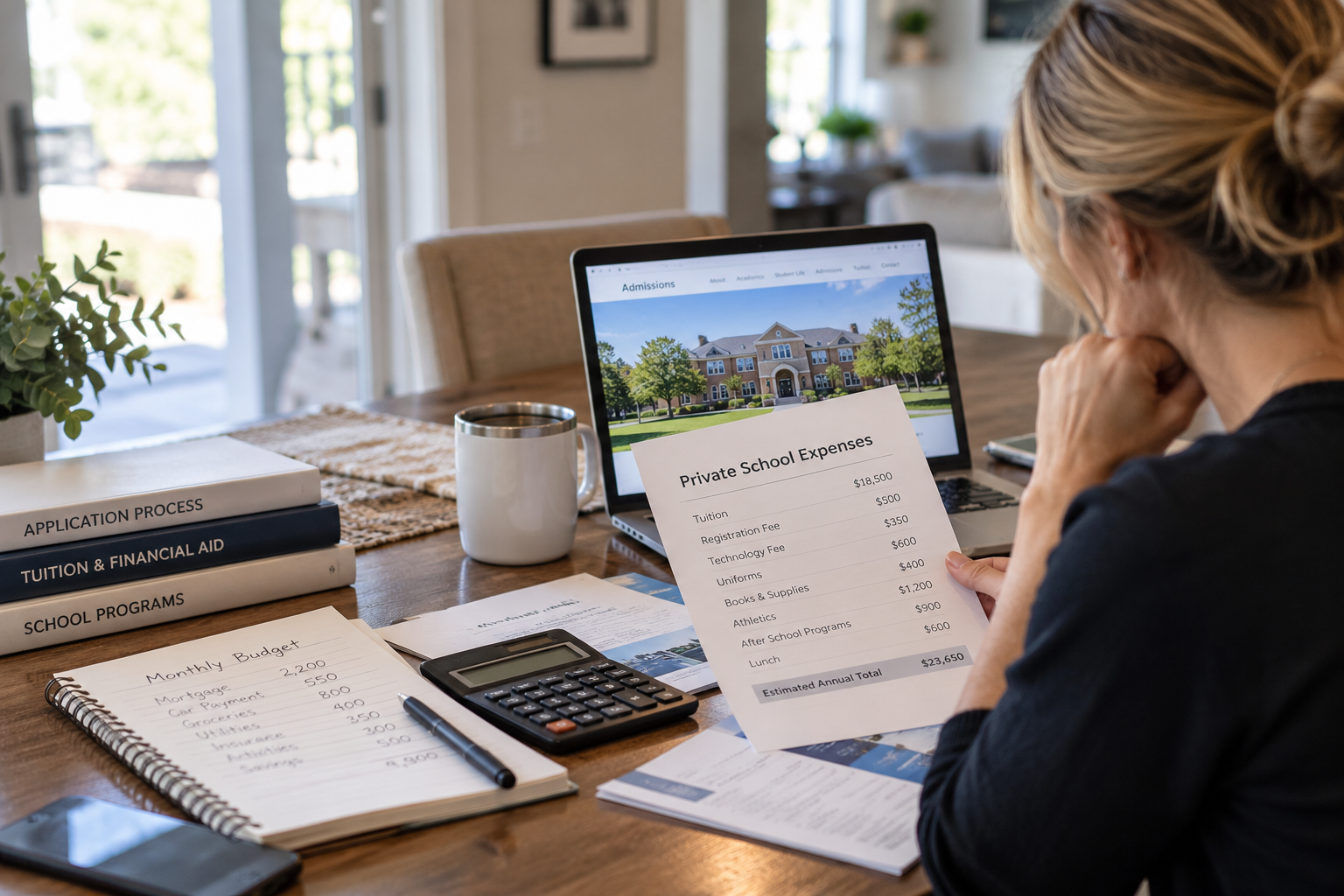
Everything above is tuition. Schools bill separately for things most families assume are included. In our Pinellas survey, required fees beyond tuition ranged from $250 to $2,600 a year across the eleven schools that publish them, and a registration or enrollment fee appeared at eleven of the twelve. At one school that fee is $1,400, annual, and non-refundable. After-school care, where offered, ran $1,800 to $3,250 a year.
The other direction matters just as much. Many families pay well below the sticker price after financial aid, scholarships, parish or member rates, sibling discounts, and state school choice money. Our full affordability guide covers each lever, includes a net-cost calculator, and has a worksheet you can fill in during an admissions meeting.
6. Florida vs. Texas: what state money does to the math
Florida and Texas have nearly identical average tuition — $12,501 and $12,796, a gap of $295 — but their state programs work differently, and so does what a family pays out of pocket.
| Florida (FTC / FES-EO) | Texas (Education Freedom Accounts) | |
|---|---|---|
| Award, private school student | $8,643 (K–3), $8,059 (4–8), $7,868 (9–12), set by county and grade | $10,474, the same for every grade (85% of the state's average per-student funding) |
| Students with disabilities | Unique Abilities scholarship, roughly $10,000–$10,800 for most Pinellas students, more for the highest needs | Up to $30,000 with an IEP on file, based on what the home district would receive |
| Income limit | None for eligibility; lower-income families are funded first | None for eligibility; priority tiers applied in year one |
| Demand vs. funding | No cap on participants in FES-EO since 2023–24 | Applications exceeded available awards; the state reported over 274,000 applications, and roughly 85,000 students had been funded by late July |
| 2026–27 application window | New private school applications open through November 15, 2026 | Closed — ran February 4 to March 31, 2026 |
| How money reaches the school | Quarterly, paid to the school after the parent approves each payment | 25% installments (July 1 and October 1, 2026), then 50% on February 1, 2027 |
| Homeschool | Separate Personalized Education Program | Up to $2,000 a year |
What the award is worth against the average
Set each state's award against its own average tuition and the difference is visible. Texas's $10,474 covers about 82% of the state's $12,796 average. Florida's Pinellas awards ($7,868 to $8,643) cover roughly 63% to 69% of the state's $12,501 average. As an illustration, before fees or any school aid, an average-priced school would leave a Texas family with an award about $2,322 to pay, and a Pinellas family in grades 4–8 about $4,442.
That Texas comparison only applies to families who received an award. In the first program year, demand outran funding, so a family without one pays full price. Florida's program has no participant cap for FES-EO, but it has its own traps: not every private school accepts state scholarships, and deadlines for accepting the award, enrolling, and withdrawing from public school are separate steps. The affordability guide walks through each Florida deadline.
These are comparisons of averages, and an average includes schools most families would never consider, so use them to understand the shape of each program rather than to predict your own bill.
7. What to do with these numbers
- Get a written total cost. For each school you're seriously considering, ask for tuition, every required fee, and what's included for your child's specific grade.
- Find out what's available to you. Check your state's school choice program first, then apply for each school's financial aid. Aid budgets are often committed by spring.
- Compare monthly payments, not tuition pages. Our net-cost calculator turns tuition, fees, and every source of assistance into a monthly number.
- Visit and ask. Numbers can't tell you whether a school fits your child. Our tour questions help you get answers a rating site can't.
Every state average comes from one source and one school year so the comparison is consistent. We did not blend sources for the main table. We left out year-over-year tuition inflation because the published trend figures don't line up with the current averages. School-level tuition changes every year, and flagship school prices are the most likely to move.
See what schools near you actually charge
Browse private school profiles across Pinellas County — tuition, grade levels, programs and more — and compare them side by side.
Frequently asked questions
What is the average cost of private school in the U.S.?
$13,752 a year for 2026–27, according to Private School Review. Elementary schools average $13,023 and high schools average $17,267. State averages range from $5,377 in South Dakota to $28,916 in Connecticut, and individual schools range from roughly $1,000 to well over $60,000.
How much does private school cost in Florida?
The statewide average is $12,501 a year for 2026–27, but the range is wide. The lowest posted tuition in Florida is around $1,020, and a flagship independent school such as Ransom Everglades in Miami charges $57,300. In a September 2026 survey of twelve Pinellas County schools, published tuition ran from $6,750 to $35,960.
Which state has the most expensive private schools?
By statewide average, Connecticut is highest at $28,916. Among the eight states compared here, New York leads at $21,649, followed by California at $17,574.
Is tuition the full cost of private school?
No. In a survey of twelve Pinellas County schools, required fees beyond tuition ranged from $250 to $2,600 a year, and after-school care added $1,800 to $3,250 where offered. Many families also pay less than the sticker price after financial aid, scholarships, and state school choice money.
How do Florida and Texas compare on school choice money?
Texas's Education Freedom Accounts award $10,474 to a private school student for 2026–27, and up to $30,000 for a student with an IEP. Florida's awards for Pinellas County students are $7,868 to $8,643 depending on grade. Texas's first year was rationed because demand exceeded funding, while Florida's FES-EO has had no participant cap since 2023–24.
Does a state scholarship cover full private school tuition?
Usually not. Against each state's average tuition, Texas's standard award covers about 82% and Florida's Pinellas awards cover roughly 63% to 69%. The remainder depends on the school's actual tuition, fees, and any additional aid or discounts.
Why do different websites report different average tuition?
Sources use different datasets, school years, and methods, and some include schools others leave out, such as preschools or special-education schools. We use one source and one school year for all state averages so the comparisons are consistent, and we label any figure that comes from elsewhere.
Keep reading
Sources
State and national tuition averages from Private School Review, 2026–27, read 8 October 2026. Flagship school tuition from each school's own site, 2026–27. Elementary and high school splits from educationdata.org. Texas program details from the Texas Education Freedom Accounts program and Texas Comptroller's office; Florida award amounts and deadlines from Step Up For Students. Pinellas County fee and tuition ranges from our September 2026 survey of twelve schools' published tuition pages. School figures change — always confirm current costs with the school.
- Private School Review — average private school tuition by state
- educationdata.org — average cost of private school
- Texas Education Freedom Accounts
- Step Up For Students — scholarship programs
- Florida Department of Education — Family Empowerment Scholarship
- Ransom Everglades — tuition
- Harvard-Westlake — tuition
- Latin School of Chicago — tuition
- Kent Denver School — tuition
- Harpeth Hall — tuition
- Charlotte Latin School — tuition
- The Hockaday School — tuition and fees
- Trinity School (Manhattan) — Private School Review profile